

The Microscopic Ohm: Electron Dynamics & HiFi Signal Integrity

An image illustrating The Microscopic Ohm: Electron Dynamics & HiFi Signal Integrity

For the serious practitioner of electronic design, the familiar Ohm’s Law, V = IR, is a necessary but ultimately superficial abstraction. It describes the bulk behavior of a component but reveals nothing of the underlying charge dynamics. To truly comprehend the origins of signal degradation, we must transcend this macroscopic view and descend to the level of the material itself. Here, the governing principle is not an algebraic equation but a vector relationship: J = σE. This is the microscopic, or point, form of Ohm’s Law, and it provides the foundational framework for any rigorous analysis of electron transport.

In this formulation, J represents the current density vector (in amperes per square meter), describing the magnitude and direction of charge flow at any given point within the conductor. This flow is not spontaneous; it is induced by the electric field intensity vector, E (in volts per meter), which exerts a force on the charge carriers. The material’s intrinsic ability to permit this charge movement is quantified by the scalar value σ, the specific conductance or conductivity (in siemens per meter). This equation, therefore, lays bare the fundamental mechanism: an applied electric field produces a proportional current density, governed by the material’s inherent conductivity.

Adopting this perspective is not a mere academic exercise. It is an analytical necessity. Phenomena such as skin effect, proximity effect, and the very nature of thermal noise in resistive components are incomprehensible without a firm grasp of the interplay between fields and current densities. It is from this microscopic viewpoint that we can begin to build accurate models of component non-idealities and, ultimately, design circuits that preserve signal integrity with the highest possible fidelity.

Electron Dynamics: Drift Velocity and Specific Conductance

Within a conductor’s crystalline lattice, the conduction band electrons are not static; they exhibit chaotic thermal motion at velocities approaching 106 m/s. The application of an external electric field, E, superimposes a net directional motion upon this randomness. This average velocity, known as the drift velocity (v_d), is surprisingly slow, often on the order of millimeters per second. It is not a constant acceleration, but rather a terminal velocity achieved as the force from the electric field is balanced by the resistive drag from incessant scattering events—collisions with lattice phonons, impurities, and other crystal defects.

This microscopic dynamic directly dictates macroscopic current flow. The current density, J, is quantified by the relationship J = nqv_d, where n is the number density of charge carriers and q is the elementary charge. From this, we derive the material’s specific conductance, σ. Recognizing that drift velocity is proportional to the electric field (v_d = µE, where µ is electron mobility), it follows that J = (nqµ)E. By comparing this to the point form of Ohm’s Law, J = σE, we establish a direct causal link: σ = nqµ. The bulk property of conductance is therefore an emergent phenomenon, fundamentally governed by the charge carrier density and their mobility. The latter, in turn, is inversely proportional to the frequency and severity of these electron scattering events.

Resistance Generation: Lattice Vibrations and Impurity Scattering

At the microscopic level, electrical resistance is not an intrinsic property but an emergent phenomenon resulting from electron scattering. The two dominant mechanisms are lattice vibrations and impurity scattering. In a theoretically perfect conductor at absolute zero, electrons would flow unimpeded. However, any thermal energy above 0 K induces vibrations in the atomic lattice, creating quantized mechanical waves known as phonons. These oscillations of the ionic cores present a dynamic cross-section for collision with charge-carrying electrons. An increase in temperature intensifies these vibrations, increasing the frequency of electron-phonon scattering events and drastically reducing the electron’s mean free path between collisions.

Concurrently, static imperfections within the material’s crystalline structure provide a second, largely temperature-independent scattering mechanism. Foreign atoms, vacancies, dislocations, and grain boundaries disrupt the periodic potential of the lattice, creating localized fields that deflect electrons from their ballistic trajectories. Both phonon and impurity scattering events impede the net drift velocity of electrons under an applied electric field. This degradation in charge transport is elegantly captured by the vector form of Ohm’s Law, J = σE, where a higher rate of scattering directly diminishes the specific conductance, σ. As resistivity is the reciprocal of conductance, any factor that hinders electron flow necessarily increases it. The quantitative impact and interplay of these mechanisms, however, are highly material-dependent.

Material Specificity: Quantitative Determinants of Resistivity

The macroscopic resistivity (ρ) of a conductor is not an arbitrary constant but a direct consequence of its microscopic properties, fundamentally governed by the relationship ρ = mₑ / (ne²τ), where n is the free electron density and τ is the mean free time between scattering events. The integrity of the material’s crystal lattice is a primary determinant of τ. In polycrystalline metals, grain boundaries, dislocations, and other lattice defects act as potent scattering centers, reducing electron mobility (μₑ) and thus increasing resistivity compared to a theoretical monocrystal.

The introduction of alloying elements or impurities further degrades conductance. This effect is quantified by Matthiessen’s rule, which additively separates resistivity into thermal and residual components: ρ = ρ_thermal + ρ_residual. The residual resistivity, ρ_residual, is independent of temperature and arises directly from electron scattering off solute atoms that disrupt the periodic potential of the host lattice. Concurrently, the thermal component is dictated by electron-phonon interactions. As temperature increases, lattice vibrations become more energetic, increasing the probability of scattering and shortening τ. This relationship is linearized by the temperature coefficient of resistivity (α) in the expression ρ(T) ≈ ρ₀[1 + α(T – T₀)]. Therefore, the specific conductance of any material is a quantifiable outcome of its atomic structure, chemical purity, and thermal state, each factor directly influencing electron scattering rates.

Signal Propagation: Microscopic Resistance in HiFi Contexts

The transition from a DC framework to the AC reality of an audio signal fundamentally alters the implications of microscopic resistance. The chaotic dance of electron scattering and drift velocity, while defining baseline resistivity, becomes a frequency-dependent variable in practice. At higher audio frequencies, the alternating magnetic field generated by the signal itself induces eddy currents within the conductor. These currents effectively constrict the primary electron flow to the conductor’s periphery—a phenomenon known as the skin effect. This reduces the effective cross-sectional area, increasing impedance non-linearly with frequency.

This is compounded by the proximity effect in multi-conductor geometries, where the magnetic fields of adjacent conductors further distort current distribution. Beyond the conductor, the insulating material itself introduces losses. The alternating electric field causes cyclical polarization of the dielectric’s molecules, a process that dissipates energy as heat. This dielectric loss is also frequency-dependent and contributes to signal attenuation, particularly at the upper end of the audio spectrum.

Collectively, these mechanisms introduce complex, frequency-specific impedance characteristics that directly impact signal integrity. They manifest as phase shifts that compromise temporal coherence and smear the leading edges of transients. Understanding these cumulative effects is therefore not an academic exercise, but a prerequisite for mitigating signal degradation in high-fidelity system design.

Synthesizing Microscopic Resistance for HiFi Engineering

Ultimately, macroscopic resistance is not a static property but an emergent phenomenon born from the chaotic ballet of charge carriers. We have dissected how an electron’s net drift velocity, the very essence of current, is perpetually contested by a storm of scattering events—collisions with thermally agitated lattice phonons, impurities, and crystalline defects. These interactions, dictated by a material’s intrinsic structure and thermal state, are what collectively define its specific conductance and its resulting electrical behavior. For the HiFi engineer, this microscopic perspective transforms component selection from a simple act of matching specifications to a calculated intervention in solid-state physics. The choice between a bulk metal foil resistor and a thin-film variant ceases to be arbitrary; it becomes a conscious decision about managing electron scattering pathways to minimize thermal noise generation and mitigate subtle current-dependent non-linearities.

This granular understanding is where true high-fidelity engineering resides. It is the critical bridge between abstract quantum mechanics and the palpable clarity of the resulting audio signal. Preserving the integrity of a complex, low-level waveform is fundamentally an exercise in minimizing the statistical noise and distortion introduced by these countless microscopic interactions. Thus, a rigorous, physics-driven design philosophy is not an academic indulgence; it is the absolute imperative for anyone committed to pushing the boundaries of audio verisimilitude.


Small Spaces, Big Sound: The Compact Bookshelf Speaker Revolution

An image illustrating Small Spaces, Big Sound: The Compact Bookshelf Speaker Revolution
An audiophile in a small apartment looks at large bookshelf speakers that don't fit on the shelf, while a new, compact speaker sits on a desk as a solution.

There’s a cruel irony in the term ‘bookshelf speaker’—a label for a component that, for many of us, has never seen the inside of an actual bookshelf. For the urban audiophile or anyone navigating a compact living area, this isn’t a quirk; it’s the core of the Space-Constrained Audiophile’s Dilemma. We yearn for the expansive soundstage and crystalline detail of a true high-fidelity system, yet we are constantly boxed in by the physical reality of our walls, forced into acoustic compromises.

But the landscape is shifting. A new generation of truly compact speakers is emerging, engineered not as downsized afterthoughts, but as precision instruments designed to excel in confined spaces. These designs directly challenge the old, rigid rules of placement and performance. This exploration will delve into these practical solutions, revealing how innovative engineering is finally delivering uncompromising audio for rooms where it once seemed impossible.

Beyond the Buzzword: How Compact Speakers Actually Fit and Perform

An audiophile in a small, cramped apartment measures the space around his large bookshelf speakers, which won't fit on the full bookshelf behind him.

It’s not acoustic wizardry, but smart engineering that allows today’s compact speakers to defy their size. Designers are now using long-throw woofers that move an incredible amount of air, creating deep, satisfying bass from impossibly slim profiles. The cabinets themselves are no longer just simple boxes; they are often sealed or cleverly ported and constructed from advanced, rigid materials that eliminate the muddying vibrations that plague lesser designs.

What does this mean for you? It means you can place a speaker on an actual bookshelf or desk without it creating a boomy, resonant mess. These speakers are engineered to work with your room, not against it, delivering a clear, full-bodied sound that maintains its integrity even in tight quarters. This is how we move past the compromise. These deliberate advancements in design directly solve the dilemma of limited space without sacrificing the audio quality we crave.

Small Footprint, Big Future: Practical Hi-Fi is Here

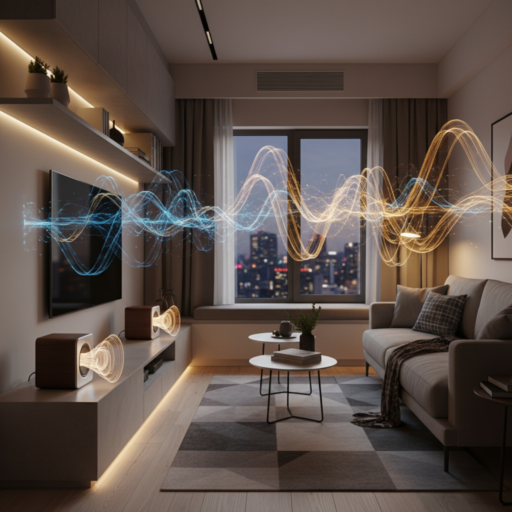
A pair of small, modern bookshelf speakers in a cozy urban apartment create an expansive soundstage visualized as glowing, ethereal waves of light filling the room.

The era of sacrificing sonic fidelity for living space is decisively over. Through intelligent acoustic design and innovative engineering, we’ve reached a pivotal moment where high-performance audio is no longer tethered to large cabinets and dedicated rooms. The humble bookshelf speaker, for too long a category of compromise, can now genuinely deliver on its promise—performing with astonishing depth and clarity from the very furniture it’s named after.

This is more than a product trend; it’s a fundamental shift that redefines the landscape of home audio. For urbanites and space-conscious enthusiasts, immersive, high-quality sound is finally an attainable, everyday reality rather than a distant aspiration. The future of audio is not about making things bigger, but smarter. It’s a future focused on enhancing the listener’s real-world experience, proving that the best sound systems are, and will continue to be, the ones we can truly live with.

The Pipe Organ’s Echo: Shaping an Audiophile’s Ear

An image illustrating The Enduring Echo: A Journey Through Antique Organ Acoustics

I remember the stillness first, the cool, heavy air of the old nave thick with the scent of aged oak and beeswax. My eyes traced the towering façade of the pipe organ, a colossal architecture of polished metal and dark, carved wood that seemed to hold its breath in the silence. Then, the first note sounded. It was not something merely heard; it was a physical event. A low pedal tone, born from a pipe taller than a man, vibrated through the stone floor, up through the solid pew, and resonated deep in my chest. It was a wave of pure, unamplified acoustic energy that displaced the very air around me.

As the chord bloomed, filling the cavernous space, it was overwhelming—a complex, breathing texture of harmonics and overtones that no speaker could ever replicate. This was not a recording of sound; this was sound itself, in its most elemental and breathtaking form. That initial, visceral shock of acoustic power became a permanent benchmark, an unforgettable resonance etched not just in my memory, but in my very being.

Unveiling the Mechanism: Architecture and Air

The initial wave of sound, a physical presence that commands the very air, eventually gives way to a dawning curiosity. The ear begins to dissect the experience, seeking the source of this power. One starts to imagine the immense, yet precisely controlled, wind pressure building in the bellows—a stored breath waiting for release. You can almost feel the subtle, tactile connection of the tracker action, that intricate network of wood and wire linking the organist’s touch directly to the valve of a pipe. Each note is not merely triggered; it is actuated, a physical event connecting human intent to mechanical voice.

But the mechanism is incomplete without its partner: the architecture itself. The organ and the sanctuary are not two separate entities, but a single, symbiotic instrument. The cold stone floors, the resonant warmth of aged wood panelling, the soaring height of the vaulted ceiling—these are not passive surfaces. They are the organ’s final and largest resonators, shaping the sound’s decay, amplifying its harmonics, and allowing the chords to bloom and linger in the space. This is where air, wood, and stone conspire to create an acoustic signature impossible to replicate elsewhere.

Echoes Beyond the Nave: From Pew to Playback

That memory of true acoustic space became my benchmark, a three-dimensional ghost that haunted my early encounters with recorded music. The first time I tried to recapture that cathedral’s grandeur on a turntable, the result was a study in compromise. The organ’s seismic pedal tones, which once vibrated through the floorboards and into my bones, were now a flattened suggestion in a vinyl groove. The shimmering complexity of the upper ranks felt compressed, a beautiful photograph of a living thing. Yet, there was a revelation in this reduction: the ability to summon that echo, however faint, on command.

This was the beginning of a different kind of listening. My ear, calibrated by the unassailable authenticity of the nave, began a new apprenticeship. It learned to search for the phantom reverberations and spatial cues buried within the recording, seeking to rebuild the cathedral in the mind. It was a transition from experiencing sound to deconstructing it, a journey that would inevitably lead to the modern pursuit of perfect playback.

The Calibrated Ear: Pursuing Acoustic Truth

That foundational encounter with the pipe organ is not a passive memory; it is an active, internal reference—an acoustic truth against which all reproduced sound is measured. The memory of its effortless dynamic swell, from a whisper to a physical tremor, and the sheer spatial immersion of sound reflecting off stone becomes the ultimate benchmark. Every component in my modern system is chosen with the express purpose of chasing that ghost. The selection of speakers is a search for drivers that can convey both the delicate air of a single flute stop and the thunderous weight of a 32-foot pedal tone without strain or coloration.

Amplifiers are judged on their ability to deliver instantaneous, uncompressed power, mirroring the organ’s infinite headroom. Even digital sources are scrutinized for their capacity to resolve the complex harmonics and ambient decay that define a real acoustic space. This is not simply a hobby; it is a discipline. The goal is to assemble a system that doesn’t just play music but reconstructs that original, visceral experience. The result is a calibrated ear, one permanently tuned by the unamplified purity of the past and forever dissatisfied with anything less than authentic emotional resonance.

An Enduring Legacy: The Organ’s Unseen Influence

Our journey through the ages of sound, from the colossal, air-driven mechanics of the pipe organ to the precision of modern digital-to-analog converters, reveals a continuous thread. It all circles back to that first, profound encounter—the moment a historic organ filled a physical space not just with sound, but with palpable, acoustic energy. That experience becomes a permanent calibration for the ear, an ingrained reference point for what pure, unamplified sound can achieve in three-dimensional space.

This foundational memory is not a cudgel with which to beat modern technology. Far from it. Instead, it serves as an essential baseline that enriches our appreciation for high-fidelity audio. It allows us to better understand the monumental task our systems undertake in recreating that sense of presence and scale. In our lifelong pursuit of emotional depth and acoustic authenticity, that ‘old church organ’ remains the unseen benchmark, the silent, resonant ghost in our meticulously engineered machines. It is the enduring standard against which all other sonic experiences are, consciously or not, measured.

Greetings!

Welcome to the Valensona family. This is where you can be among the dedicated audiophiles with their “ear to the ground” for sound. Find out what we’re getting ready for stores and what others are saying. We look forward to hearing from you too!